Best Free Bookmarking Software 2026: Organize Your Digital Life
In the fast-evolving digital landscape of 2026, the sheer volume of information we consume daily is staggering. For professionals managing high-stakes projects and students navigating complex academic curricula, the ability to save, categorize, and retrieve information quickly is no longer just a “nice-to-have” skill—it is a competitive necessity. We have moved far beyond the era of simple browser “favorites.” Today, the best free bookmarking software acts as a secondary brain, utilizing artificial intelligence, cross-platform synchronization, and deep search capabilities to transform a chaotic stream of URLs into a structured library of knowledge.
Whether you are trying to curate research for a thesis, save industry reports for a quarterly review, or simply keep track of long-form articles for weekend reading, the right tool can save you hours of “tab hunting.” In this guide, we explore the top-tier free bookmarking solutions available in 2026, focusing on tools that offer robust functionality without a subscription fee, helping you streamline your workflow and reclaim your focus.
1. The Evolution of Bookmarking: Why 2026 Demands More
The bookmarking landscape has undergone a radical transformation. In the early 2020s, a bookmark was merely a static link. By 2026, the concept has expanded into “Personal Knowledge Management” (PKM). The modern professional doesn’t just want to save a link; they want to archive the content of the page, annotate it, tag it with AI-generated keywords, and perhaps even generate a three-sentence summary of the article before they even click on it.
Standard browser bookmarks often fall short because they are tethered to a specific ecosystem and offer poor searchability across different devices. Furthermore, they lack the “visual” aspect that many creative professionals need. The software we discuss today addresses these gaps by offering cloud-based storage, offline access, and the ability to handle various media types beyond just text, including PDFs, YouTube videos, and social media threads.
2. Raindrop.io: The Gold Standard for Visual Organization
If you are a professional who thrives on visual cues, **Raindrop.io** remains the premier choice in 2026. It is widely regarded as the most beautiful and versatile bookmarking app on the market. Raindrop treats your bookmarks like a gallery, allowing you to view saved links as cards, headlines, or a simple list.
#
Key Features for 2026:
* **Deep Search:** Even in the free version, Raindrop allows you to search through the titles and descriptions of your saved items with incredible speed.
* **Nested Collections:** Organize your work into folders and sub-folders, which is essential for students managing multiple subjects or professionals handling various clients.
* **Collaboration:** You can share collections with teammates or classmates, making it a powerful tool for group projects.
* **Device Ubiquity:** With extensions for Chrome, Firefox, Safari, and dedicated apps for iOS and Android, your bookmarks are always within reach.
For the budget-conscious user, Raindrop’s free tier is incredibly generous, offering unlimited bookmarks and collections. It’s the perfect “set it and forget it” tool that grows with your digital library.
3. Pocket: The Professional’s Reading List
For many students and busy executives, the problem isn’t finding content—it’s finding the *time* to consume it. **Pocket** (owned by Mozilla) continues to dominate the “read-it-later” niche in 2026. Pocket’s primary strength lies in its ability to strip away advertisements, sidebars, and digital clutter, presenting you with a clean, text-focused interface that is easy on the eyes.
#
Why it excels for students and researchers:
* **Offline Access:** Pocket downloads the text of your bookmarks automatically. This is a lifesaver for students commuting via subway or professionals traveling for work without reliable Wi-Fi.
* **Listen to Articles:** Pocket’s high-quality text-to-speech engine allows you to “listen” to your bookmarks. In 2026, the AI voices are nearly indistinguishable from human narrators, turning your saved articles into a personalized podcast.
* **Tagging System:** While it lacks the folder structure of Raindrop, its tagging system is robust, allowing for quick filtering of content by topic or urgency.
Pocket’s free version is more than sufficient for most users, providing a distraction-free environment to catch up on the latest industry trends or academic papers.
4. Toby: The Tab Manager for High-Performance Workflows
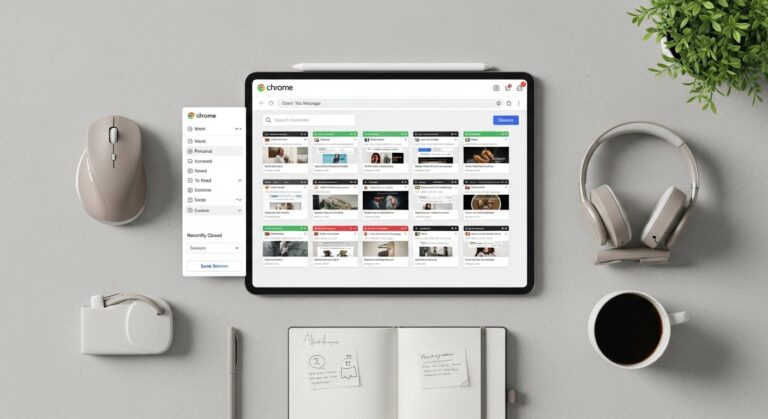
While other tools focus on long-term storage, **Toby** is designed for the immediate “now.” For professionals who find themselves with 40 tabs open by noon, Toby is the ultimate productivity hack. It lives in your “New Tab” page, allowing you to drag and drop open tabs into organized sessions.
#
Boosting Workflow in 2026:
* **Context Switching:** You can create a “Morning Routine” session with your email, calendar, and news, and a “Project X” session with relevant research and documents. With one click, you can close all “Morning” tabs and open all “Project X” tabs.
* **Space Management:** Toby helps reduce browser memory usage, which is crucial for those working on laptops with limited RAM.
* **Team Spaces:** Professionals can use Toby to onboard new employees by sharing a “Welcome” session containing all the necessary links and tools for their first day.
For students, Toby is an excellent way to keep research for different classes separated, ensuring that a psychology paper’s tabs don’t get mixed up with a calculus assignment.
5. Notion and Web Clippers: The All-in-One Database
While not a “bookmarking app” in the traditional sense, **Notion** has become a powerhouse for digital organization in 2026. By using the **Notion Web Clipper**, you can save any webpage directly into a Notion database.
#
The Power of Integration:
* **Custom Meta-Data:** Unlike simple bookmarking apps, Notion allows you to add custom fields to your bookmarks, such as “Date Read,” “Priority,” or “Assigned To.”
* **Turning Links into Action:** A bookmarked link in Notion can easily be turned into a task, a project note, or part of a larger wiki.
* **Rich Previews:** Notion captures the essence of the page, often pulling in images and excerpts that make your database feel like a curated magazine.
This is the preferred method for power users who want their bookmarks to live alongside their notes, calendars, and project management boards. If you are already using Notion for your studies or work, its bookmarking capabilities are a natural extension of your workflow.
6. Diigo: Built for Scholarly Research
For students and academics, **Diigo** (Digest of Internet Information, Groups and Other stuff) remains a specialized favorite in 2026. It goes beyond mere bookmarking by focusing on “social annotation.”
#
Scholarly Features:
* **Digital Highlighting:** You can highlight sections of a webpage as if it were a physical textbook. When you return to the link, your highlights are still there.
* **Sticky Notes:** Add notes to specific parts of a page to remind yourself why a particular paragraph is relevant to your research.
* **Outliner:** Diigo allows you to compile your highlights and notes into an outliner, making the transition from “reading” to “writing a draft” seamless.
Diigo’s free tier is slightly more restrictive than Raindrop’s, but for those who need to engage deeply with text-heavy web content, its annotation tools are unparalleled.
7. Security and Privacy: Choosing a Tool You Can Trust
In 2026, digital privacy is a paramount concern. When choosing a “free” tool, it is important to understand the trade-off. Many free services monetize your data by tracking your browsing habits. For professionals dealing with sensitive company information or students concerned about data sovereignty, seeking tools with strong encryption and clear privacy policies is essential.
Open-source alternatives like **Wallabag** have gained popularity in 2026 for this reason. Wallabag allows you to self-host your bookmarks, ensuring that no third-party corporation has access to your reading list. While self-hosting requires a bit of technical knowledge, the peace of mind regarding data privacy is a significant draw for many in the professional sector.
—
FAQ: Frequently Asked Questions
#
1. Can I migrate my bookmarks between these apps?
Yes. Almost all reputable bookmarking software in 2026 allows you to export your data as an HTML or CSV file. This means you can start with a tool like Pocket and, if your needs change, move your entire library to Raindrop.io or Notion without losing your links.
#
2. Do these tools work across different browsers?
Most of the tools mentioned—especially Raindrop, Pocket, and Toby—offer extensions for all major browsers including Chrome, Firefox, Edge, and Safari. They also offer mobile apps that sync in real-time, ensuring your bookmarks are available on your phone, tablet, and desktop.
#
3. Is “free” software really safe for professional use?
“Freemium” models are standard in 2026. These companies offer a robust free tier to attract users and charge for advanced features like AI-powered full-text search or unlimited permanent archives. For most professional use cases, the free versions are highly secure and provide sufficient functionality.
#
4. How does AI improve bookmarking in 2026?
AI has revolutionized bookmarking by enabling “Semantic Search.” Instead of remembering a specific keyword, you can search for a concept (e.g., “that article about renewable energy in Scandinavia”), and the AI will find the relevant bookmark based on the content of the page, even if the title doesn’t contain those exact words.
#
5. Will using these extensions slow down my browser?
Modern browser extensions are highly optimized. However, having 20 different extensions active can impact performance. It is best to choose one primary bookmarking tool and one tab manager (like Toby) to keep your browser running smoothly.
—
Conclusion: Crafting Your Personal Knowledge Engine
As we navigate the complexities of 2026, the ability to curate information is what separates the overwhelmed from the organized. The “best” free bookmarking software is ultimately the one that fits seamlessly into your existing habits.
For the visual thinker, **Raindrop.io** provides a stunning interface to browse your digital world. For the researcher, **Diigo** offers the tools to dissect and analyze complex information. For the busy professional, **Toby** and **Pocket** offer immediate relief from tab overload and time constraints.
By implementing one of these tools today, you aren’t just saving a link; you are building a repository of knowledge that will serve you throughout your career and academic journey. Start small, categorize as you go, and watch as your digital clutter transforms into a powerful asset for success.