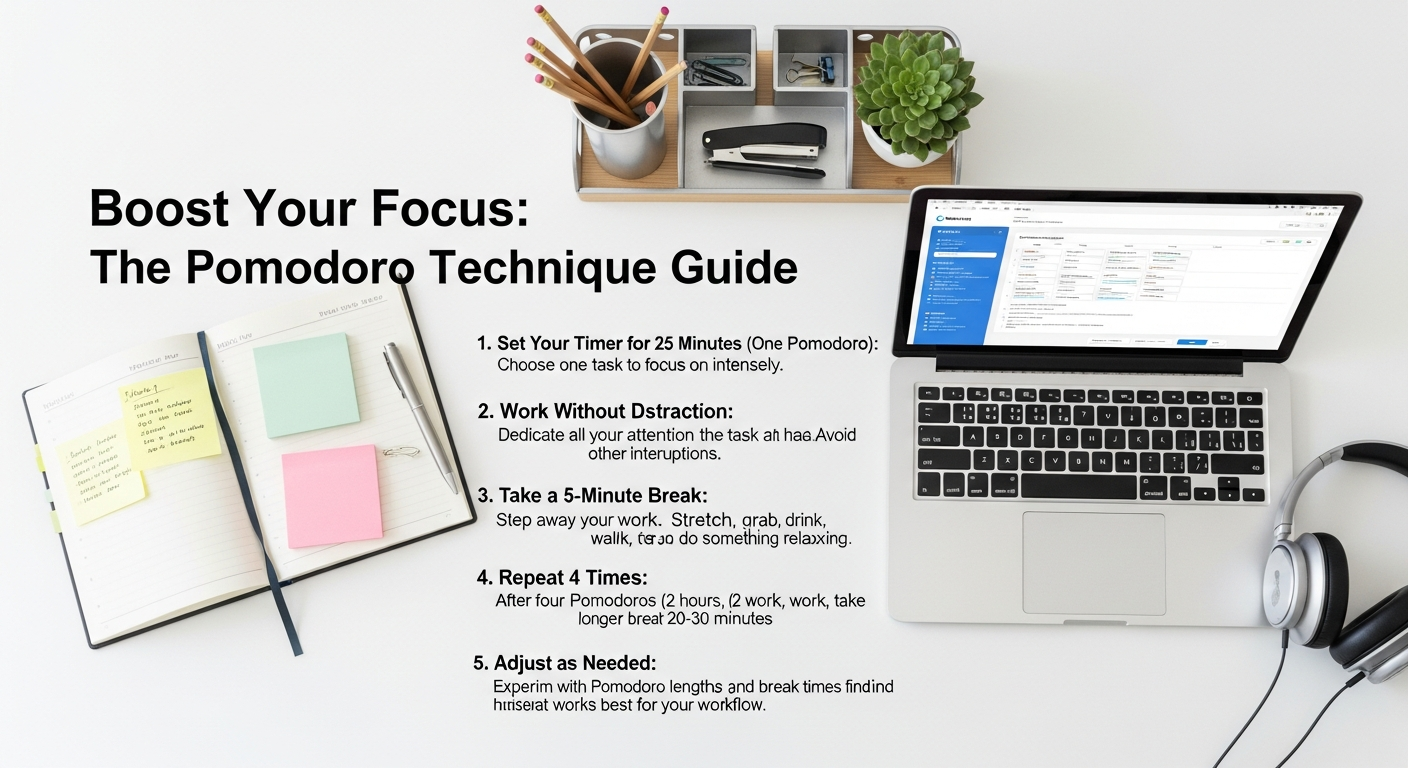

What is the Pomodoro Technique?
The Pomodoro Technique is a revolutionary time management method developed by Francesco Cirillo in the late 1980s. Its name, “Pomodoro,” is Italian for “tomato,” inspired by the tomato-shaped kitchen timer Cirillo used during his university studies. At its core, the technique is elegantly simple: break down your work into focused intervals, traditionally 25 minutes in length, separated by short breaks. These 25-minute work periods are known as “Pomodoros.” The power of the Pomodoro Technique lies in its ability to cultivate deep concentration, mitigate the impact of distractions, and foster a sustainable work rhythm that prevents burnout.
Cirillo’s initial motivation for creating the technique stemmed from his own struggles with focus and procrastination. He observed that by committing to short, intense bursts of work, followed by mandatory breaks, he could maintain a higher level of concentration and productivity over longer periods. The strict delineation between work and rest periods helps train the brain to stay focused during the work intervals, knowing that a reprieve is always just around the corner. This cyclical approach not only improves focus but also helps in accurately estimating the time required for tasks, leading to better planning and project management.
Beyond simply setting a timer, the Pomodoro Technique encourages a mindful approach to work. It’s not just about getting things done faster; it’s about getting them done smarter, with greater quality and less mental fatigue. By systematically integrating short, restorative breaks, the technique ensures that cognitive resources are regularly replenished, allowing for sustained performance throughout the day. This structured approach to time management has transcended its humble origins to become a globally recognized method, adopted by students, professionals, and creatives alike, all seeking to conquer digital overload and achieve their productivity goals.
The Core Components of the Pomodoro Technique
To truly grasp and effectively implement the Pomodoro Technique, it’s essential to understand its foundational elements. These components work in harmony to create a structured yet flexible framework for managing your time and attention. Each part plays a crucial role in cultivating focus, preventing fatigue, and ultimately enhancing your overall productivity.
- The Pomodoro (25-Minute Work Interval): This is the heart of the technique. A Pomodoro is a dedicated, uninterrupted 25-minute block of time during which you commit to working on a single task with absolute focus. The key here is absolute commitment: no checking emails, no social media, no personal errands – just the task at hand. The relatively short duration makes the commitment manageable, reducing the likelihood of procrastination and making daunting tasks seem less intimidating.
- Short Breaks (5 Minutes): Following each 25-minute Pomodoro, you take a mandatory 5-minute break. These short breaks are vital for mental rejuvenation. They are not for continuing work or planning; instead, they are an opportunity to step away from your screen, stretch, grab a glass of water, or simply rest your eyes. These mini-resets prevent mental fatigue, allowing you to return to your next Pomodoro feeling refreshed and ready to refocus.
- Long Breaks (15-30 Minutes): After completing four Pomodoros (and their accompanying short breaks), you reward yourself with a longer break, typically ranging from 15 to 30 minutes. This extended pause is crucial for consolidating learning, allowing your brain to process information, and providing significant rest before starting the next cycle of four Pomodoros. During a long break, you might engage in a more substantial activity like taking a short walk, meditating, or enjoying a snack, ensuring a deeper level of recuperation.
- The Timer: The timer is not just a tool; it’s a commitment device. Whether it’s a physical kitchen timer, a desktop application, or a mobile app, the act of setting and hearing the timer signifies the start and end of your focused work and break periods. Its ticking sound or visual countdown provides a gentle, constant reminder of the time constraint, encouraging you to stay on task. The ritual of setting the timer is a powerful psychological trigger that helps transition your mind into a state of focused work.
- Tracking and Recording: While optional for some, tracking your Pomodoros is a highly recommended component. Cirillo himself advocated for marking an ‘X’ after each completed Pomodoro. This simple act provides a tangible record of your accomplishments, fostering a sense of progress and motivation. Over time, this data can offer valuable insights into your productivity patterns, helping you to refine your task estimations, identify peak performance times, and troubleshoot areas where you might be struggling. It transforms the technique from a mere timer into a powerful analytical tool for continuous self-improvement.
Understanding and respecting each of these components is crucial for harnessing the full potential of the Pomodoro Technique. It’s a holistic system designed to not only manage time but also to manage energy, attention, and mental well-being.
Step-by-Step Guide: How to Implement Pomodoro Effectively
Choosing Your Task
Before you even touch a timer, the first crucial step is to select the task you intend to work on. This might seem obvious, but clarity here is paramount. Avoid vague goals like “work on project.” Instead, break down your work into specific, actionable items. For example, instead of “write report,” aim for “draft introduction for Q3 sales report” or “research data for market analysis section.” If a task is too large to fit into a single 25-minute Pomodoro, break it down further. If it’s too small (e.g., “send one email”), combine it with other small, related tasks to fill a Pomodoro. The goal is to have a single, clearly defined objective for each focused work block.
Setting Your Timer
Once your task is clear, it’s time to set your timer for 25 minutes. While the original method utilized a physical kitchen timer, today’s digital landscape offers a plethora of options. You can use a simple stopwatch on your phone, a dedicated desktop application, or one of the many web-based Pomodoro timers available. The crucial aspect is the commitment that comes with setting it. This act mentally signals the start of your focused work period. Place the timer where you can see or hear it, as its presence serves as a constant, gentle reminder of your commitment to the task at hand.
Focused Work
This is where the magic happens. For the next 25 minutes, immerse yourself completely in your chosen task. The fundamental rule during a Pomodoro is absolute focus and no interruptions. This means no checking emails, no answering non-urgent phone calls, no browsing social media, and no engaging in conversations that aren’t directly related to your task. If an urgent interruption arises that cannot be postponed, follow the “inform, negotiate, and call back” strategy: inform the interrupting party you’re busy, negotiate a time to address their need, and then get back to your Pomodoro. If you absolutely must stop, “abort” the Pomodoro and start a new one when you can fully commit. The goal is to build your “focus muscle” and train your brain to concentrate for extended periods.
Short Breaks
As soon as the timer rings, indicating the end of your 25-minute Pomodoro, immediately take a 5-minute break. This break is non-negotiable and just as important as the work period. Resist the urge to “just finish this one thing.” Use these five minutes to step away from your workstation. Stand up, stretch, walk around, look out a window, get a drink of water, or do some light physical activity. The key is to disengage from cognitive work and rest your eyes and mind. Avoid activities that might pull you back into work or drain your mental energy, such as checking social media or reading news headlines. These short, restorative pauses are essential for preventing mental fatigue and maintaining high-quality focus for subsequent Pomodoros.
Long Breaks
After completing four Pomodoros (and their corresponding four short breaks), it’s time for a longer, more substantial break, typically 15-30 minutes. This extended period of rest is crucial for deep mental recovery and consolidation. Use this time to truly disengage. You might take a short walk outdoors, have a snack, meditate, listen to music, or engage in a brief personal activity that helps you recharge. This long break acts as a mental reset button, allowing you to return to your work refreshed, with renewed energy and perspective for the next set of Pomodoros. It’s a vital component for sustaining productivity over an entire workday and preventing burnout.
Tracking Your Pomodoros
While often overlooked, tracking your completed Pomodoros offers significant benefits. Cirillo’s original method involved simply marking an ‘X’ on a piece of paper for each finished Pomodoro. Today, many digital Pomodoro apps include built-in tracking features. Keeping a record allows you to visualize your progress, which can be highly motivating. More importantly, over time, this data provides valuable insights into your work patterns. You can identify how many Pomodoros a particular type of task typically requires, helping you improve your future task estimations. It also highlights your most productive times of the day, allowing for better scheduling. Furthermore, tracking can reveal patterns of distraction or difficulty, enabling you to address and overcome challenges in your workflow, continuously refining your application of the technique.
Benefits of the Pomodoro Technique for Digital Productivity
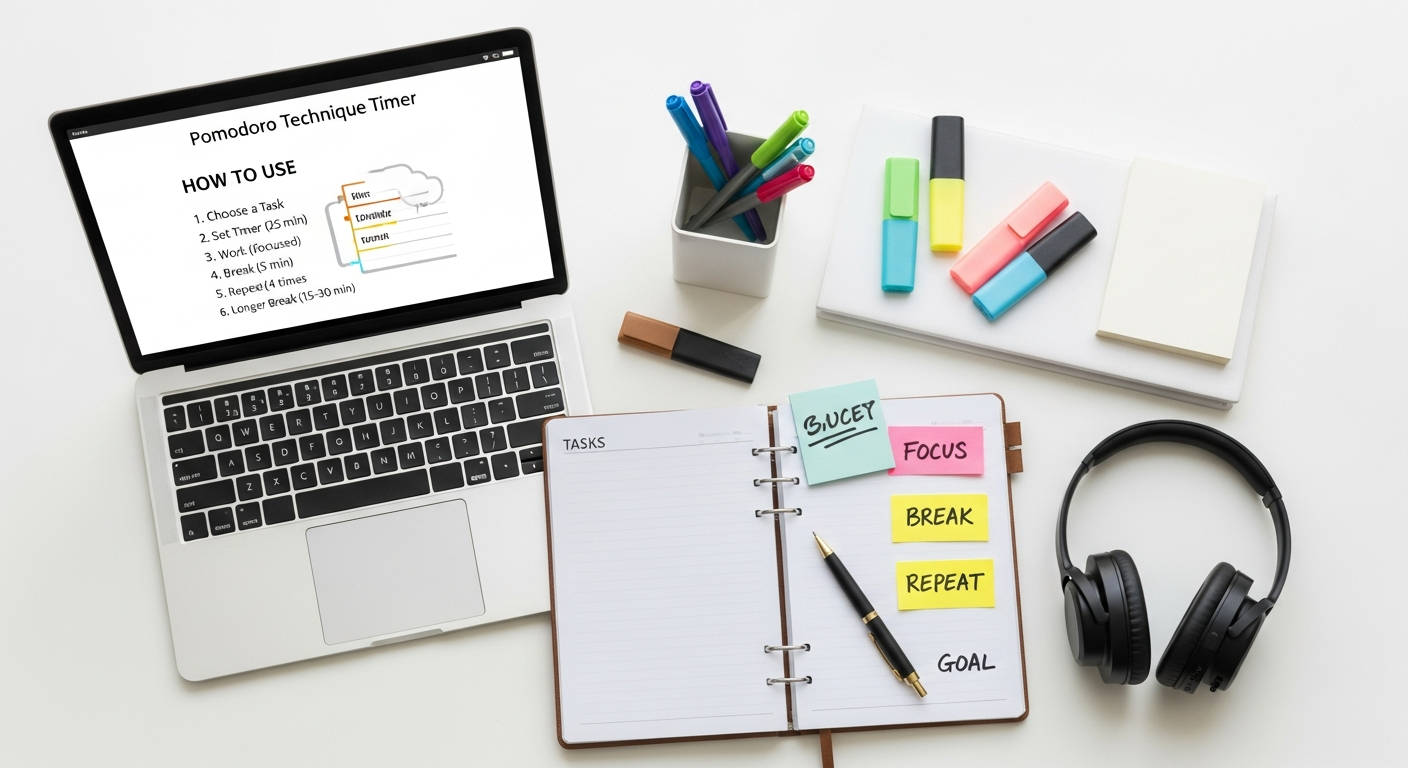
In the fast-paced digital age, where distractions are abundant and demands on our attention constant, the Pomodoro Technique stands out as a beacon for enhanced digital productivity. Its structured approach offers a multitude of benefits that directly address the challenges of modern work, helping individuals to not only get more done but to do so with greater focus and less stress.
- Enhanced Focus and Concentration: The primary benefit of the Pomodoro Technique is its ability to cultivate deep work. By committing to 25-minute sprints of uninterrupted focus, you train your brain to concentrate more effectively. The ticking timer creates a sense of urgency and accountability, compelling you to dive deep into your task and block out digital noise. This structured focus helps in breaking the habit of constant task-switching, leading to higher quality output and a more profound understanding of the material.
- Reduced Procrastination: Large, daunting tasks often lead to procrastination. The Pomodoro Technique tackles this by breaking down work into manageable 25-minute chunks. Committing to just 25 minutes of work feels far less intimidating than committing to several hours. This ‘small steps’ approach makes it easier to start, building momentum and gradually chipping away at even the most overwhelming projects. The promise of a break after a short sprint also acts as a powerful motivator to begin.
- Improved Time Management and Estimation: Consistently working in Pomodoros provides valuable data on how long tasks truly take. Over time, you’ll develop a more accurate sense of how many Pomodoros are needed for different types of activities. This improves your ability to estimate project timelines, plan your day more effectively, and set realistic deadlines. Better time estimation leads to less stress and more predictable project completion, which is vital in collaborative digital environments.
- Prevention of Burnout and Mental Fatigue: The mandatory short and long breaks are integral to preventing burnout. In the digital realm, it’s easy to fall into the trap of continuous work, leading to mental exhaustion and decreased productivity. By forcing regular disengagement, the Pomodoro Technique ensures that your brain gets adequate rest, allowing cognitive resources to replenish. This cyclical pattern of intense work followed by intentional rest is crucial for sustaining peak performance throughout the day and maintaining long-term well-being.
- Increased Awareness of Distractions: When you commit to a Pomodoro, any interruption that breaks your focus becomes immediately apparent. This heightened awareness allows you to identify your most common distractions, whether they are internal (e.g., wandering thoughts, checking phone) or external (e.g., notifications, colleagues). Once identified, you can proactively develop strategies to mitigate them, such as turning off notifications, using website blockers, or communicating ‘do not disturb’ times to teammates.
- Better Work-Life Balance: By clearly delineating work periods from break periods, the Pomodoro Technique helps establish healthier boundaries. When your work is structured and focused, you’re often more efficient, which can lead to completing tasks within designated work hours. This reduces the likelihood of work spilling over into personal time, contributing to a better work-life balance – a critical aspect of sustainable digital productivity.
Furthermore, the utility of the Pomodoro Technique is amplified when integrated with modern tools. Many of the best productivity apps 2026 offer built-in Pomodoro timers, task management integrations, and tracking features that complement the technique perfectly. These digital aids make it even easier to implement, customize, and stick to your Pomodoro cycles, truly transforming your digital workflow.
Advanced Tips and Customizations
While the core Pomodoro Technique is highly effective as is, its true power lies in its adaptability. As you become more proficient, you can fine-tune the method to better suit your unique workflow, tasks, and personal preferences. These advanced tips and customizations can help you optimize the technique for even greater digital productivity.
Adjusting Pomodoro Lengths
The standard 25-minute Pomodoro is a great starting point, but it’s not a rigid rule. Some tasks, like deep coding or complex writing, might benefit from longer focus blocks. Experiment with 45-minute or 50-minute Pomodoros followed by 10-minute breaks. Conversely, if you’re feeling particularly unmotivated or tackling very fragmented tasks, shorter Pomodoros (e.g., 15 minutes) might be more effective to kickstart your focus. The key is to find the sweet spot where you can maintain intense concentration without feeling overwhelmed or losing steam before the timer rings.
Batching Similar Tasks
Maximize efficiency by grouping similar tasks into dedicated Pomodoros. For instance, dedicate one or two Pomodoros solely to answering emails and messages. Another Pomodoro might be for administrative tasks like scheduling or expense tracking. This reduces context-switching costs, allowing your brain to stay in a specific mode of operation and perform related tasks more efficiently. It’s particularly useful for tasks that require similar mental faculties or software tools.
Handling Interruptions Gracefully
While the ideal Pomodoro is interruption-free, real-world work environments often make this challenging. Develop a system for handling interruptions. For non-urgent requests, maintain a “distraction log” where you quickly jot down the thought, question, or reminder, and then immediately return to your Pomodoro. You can address these items during your next scheduled break or a dedicated “catch-up” Pomodoro. For truly urgent interruptions, follow the “inform, negotiate, and call back” strategy mentioned earlier, but also consider if your environment can be optimized to reduce such occurrences (e.g., “do not disturb” signs, noise-cancelling headphones).
Integrating with Other Productivity Tools and Methods
The Pomodoro Technique integrates seamlessly with various digital productivity tools and methodologies, creating a powerful synergy. For those managing complex projects or extensive research, learning how to use Obsidian for note taking can be a game-changer when combined with Pomodoro. Use your short breaks to quickly jot down insights or fleeting ideas in Obsidian, ensuring no valuable thought is lost. Dedicate an entire Pomodoro to structuring your notes, linking concepts, or refactoring your knowledge base in Obsidian, knowing your focused work will be uninterrupted. This combination allows for both deep work on tasks and efficient knowledge management.
Furthermore, in today’s remote and hybrid work environments, understanding cloud computing explained simply is vital for seamless collaboration and access to resources. The Pomodoro Technique can help you dedicate focused blocks to leverage cloud-based tools effectively. Use a Pomodoro to work on a shared document in Google Docs or Microsoft 365, or to manage project tasks in Asana or Trello, all of which are powered by cloud computing. By segmenting your time, you ensure that your contributions to shared projects are efficient and distraction-free, maximizing the benefits of cloud-based collaboration without getting lost in endless tabs and notifications.
Team Pomodoros and Collaborative Focus
If you work in a team, consider implementing “Team Pomodoros.” Agree on a shared Pomodoro schedule where everyone commits to focused work during specific 25-minute blocks, followed by synchronized breaks. This creates a collective environment of focus, reducing interruptions and fostering a culture of deep work. During breaks, team members can quickly sync up or address urgent matters. This approach is particularly effective for distributed teams leveraging cloud-based communication and project management platforms.
Review and Adapt
Regularly review your Pomodoro sessions. Are 25 minutes still working for you? Are your breaks truly restorative? Are you consistently underestimating or overestimating tasks? Use your tracking data to identify patterns and areas for improvement. The Pomodoro Technique is not a static method; it’s a dynamic framework that should evolve with your work habits and needs. Don’t be afraid to experiment with different timings, break activities, or task management strategies until you find what truly optimizes your personal productivity.
Common Pitfalls and How to Avoid Them
While the Pomodoro Technique is wonderfully simple and effective, like any productivity method, it comes with potential pitfalls that can diminish its impact if not recognized and addressed. Being aware of these common challenges and knowing how to navigate them is crucial for sustained success with the technique.
- Ignoring the Timer or Skipping Breaks: This is perhaps the most common mistake. The temptation to “just finish this one thing” when the timer rings for a break can be strong. However, skipping breaks defeats a core purpose of the technique: preventing mental fatigue. Similarly, ignoring the timer during a Pomodoro by getting lost in a task means you’re not truly practicing focused, time-bound work.
- How to avoid: Treat the timer as an unyielding boss. When it rings, stop immediately. Embrace the break as an essential part of the process, not an interruption. Train yourself to stop mid-sentence if necessary; you can always pick up exactly where you left off.
- Multitasking During Pomodoros: The entire premise of a Pomodoro is single-task focus. Trying to juggle emails, social media, and your primary task within the same 25-minute block destroys the benefits of deep work. Your attention gets fragmented, and you never truly enter a state of flow.
- How to avoid: Before starting a Pomodoro, close all irrelevant tabs and applications. Put your phone on silent or in another room. Use website blockers if necessary. Create a “distraction log” where you quickly note down any non-task-related thoughts or urges, promising to address them during a break.
- Not Committing to the “No Interruptions” Rule: Both self-inflicted and external interruptions can derail a Pomodoro. Allowing yourself to get pulled away by non-urgent requests or constantly checking notifications negates the focused work period.
- How to avoid: Communicate your Pomodoro schedule to colleagues or family if possible. Use “do not disturb” signs or statuses. For internal interruptions (e.g., sudden ideas), quickly jot them down in a notebook or digital scratchpad and return to your task.
- Over-Optimization and Analysis Paralysis: Some users get so caught up in tracking, analyzing, and tweaking their Pomodoros that they spend more time planning than doing. Obsessing over the perfect Pomodoro app or the ideal break activity can become a form of procrastination itself.
- How to avoid: Start simple. A physical timer and a piece of paper are enough. Focus on the core method for a few weeks before considering advanced customizations. Remember, the goal is to get work done, not to perfectly execute a system.
- Rigid Adherence Leading to Burnout: While consistency is good, being overly rigid can sometimes backfire. If you’re having an exceptionally productive flow state, breaking it strictly after 25 minutes might feel disruptive. Conversely, forcing yourself through Pomodoros when you’re genuinely exhausted can lead to frustration and burnout.
- How to avoid: Learn to listen to your body and mind. If you’re in an incredible flow, consider extending that Pomodoro to 50 minutes (a double Pomodoro), but then take a proportionally longer break. If you’re extremely tired, perhaps take a longer break before your next Pomodoro, or even decide to call it a day. The technique is a guideline, not a dictator.
- Using Breaks for Work-Related Activities: The short and long breaks are for mental rest, not for checking “quick” work emails or planning your next task. Doing so prevents your brain from truly disengaging and recharging.
- How to avoid: Designate specific, non-work-related activities for your breaks: stretch, walk, hydrate, meditate, listen to music, or simply stare out the window. Ensure these activities are genuinely restorative and pull you away from your screen and cognitive effort.
By being mindful of these common pitfalls and actively implementing strategies to avoid them, you can ensure that the Pomodoro Technique remains a powerful and sustainable tool in your productivity arsenal, helping you to maintain focus, prevent burnout, and consistently achieve your goals.
Frequently Asked Questions
Recommended Resources
Explore What Is Video Marketing And How To Use It For Your Brand for additional insights.
For more on Pomodoro technique guide, see How To Design A Poster From Scratch on Layout Scene.