
Master Keyboard Shortcuts in 2026: Your Ultimate Guide to Turbocharged Productivity
At Bookmark Sharer, we’re all about empowering modern professionals and digital-savvy readers with the tools and strategies to work smarter, not harder. This comprehensive guide will equip you with the essential knowledge, practical tips, and specific tools you need to integrate keyboard shortcuts seamlessly into your daily routine. We’ll go beyond the basics, diving into application-specific power moves and advanced customization options that will make you a true digital maestro. Get ready to ditch the mouse dependency and turbocharge your productivity in 2026 and beyond!
Why Keyboard Shortcuts Are Your Secret Weapon for 2026 Productivity
Before we dive into the “how,” let’s solidify the “why.” Understanding the profound impact of keyboard shortcuts will motivate you to make them a core part of your professional toolkit. It’s more than just speed; it’s about a complete paradigm shift in how you interact with your digital environment.
- Unleash Blazing Speed & Efficiency: This is the most obvious benefit. Every time your hand leaves the keyboard to grab the mouse, you’re breaking your rhythm. Shortcuts keep your hands on the home row, allowing you to execute commands almost instantaneously. Imagine copying and pasting, switching applications, or opening new tabs without a single click – it adds up to hours saved over weeks and months.
- Boost Ergonomics & Reduce Strain: Repetitive strain injury (RSI) is a real concern for professionals spending hours at a desk. Constant mouse usage can contribute to wrist and arm discomfort. By integrating more keyboard shortcuts, you distribute the workload, reducing repetitive motions and promoting a more ergonomic posture. Your future self (and your wrists) will thank you.
- Maintain Focus & Achieve Flow State: Ever notice how a quick mouse movement can pull your attention away from your task? Shortcuts minimize these micro-distractions. By keeping your hands on the keyboard and your eyes on the screen, you stay immersed in your work, making it easier to enter and maintain a coveted “flow state” – where productivity soars and work feels effortless.
- Project a Professional & Savvy Image: While not the primary goal, there’s an undeniable “pro” factor to effortlessly navigating your computer with keyboard commands. It signals efficiency, confidence, and a deep understanding of your tools, whether you’re presenting to a client or collaborating with colleagues.
- Unlock Hidden Features: Some applications offer functionality that’s simply faster or easier to access via a shortcut, or sometimes even exclusively available through a command palette or custom keybind. You’re not just speeding up existing actions; you’re often expanding your capabilities.
Essential Global Shortcuts Every Professional Needs

Let’s start with the foundational shortcuts that apply across most operating systems and applications. These are your daily bread and butter, the ones you should commit to muscle memory first.
Windows & macOS Basics: The Non-Negotiables
These commands are universal power-ups for your operating system and many applications. Note that `Ctrl` on Windows typically corresponds to `Cmd` (Command) on macOS.
- Copy:
Ctrl + C(Windows) /Cmd + C(macOS) – Duplicates selected text or files. - Cut:
Ctrl + X(Windows) /Cmd + X(macOS) – Moves selected text or files. - Paste:
Ctrl + V(Windows) /Cmd + V(macOS) – Inserts copied/cut content.Real Use Case: Quickly move a paragraph in a document or duplicate a file in Explorer/Finder.
- Undo:
Ctrl + Z(Windows) /Cmd + Z(macOS) – Reverts the last action. A true lifesaver! - Redo:
Ctrl + Y(Windows) /Cmd + Shift + Z(macOS) – Reapplies an undone action.Real Use Case: Made a mistake? Hit undo. Undid too much? Hit redo. Saves countless clicks.
- Save:
Ctrl + S(Windows) /Cmd + S(macOS) – Saves your current work. Use frequently!Real Use Case: Habitually hit this after every few sentences in a document to prevent data loss.
- Find:
Ctrl + F(Windows) /Cmd + F(macOS) – Opens a search bar to find text within the current document or webpage.Real Use Case: Quickly locate a keyword in a lengthy report or find a specific product on an e-commerce site.
- Select All:
Ctrl + A(Windows) /Cmd + A(macOS) – Selects all content in the current window or document.Real Use Case: Copy an entire article or apply a font change to all text in a presentation.
- Switch Applications:
Alt + Tab(Windows) /Cmd + Tab(macOS) – Cycles through open applications.Real Use Case: Seamlessly jump between your browser, email client, and document editor without touching the mouse.
- Close Application/Window:
Alt + F4(Windows) /Cmd + Q(macOS for app) orCmd + W(macOS for window/tab) – Closes the active window or application.Real Use Case: Shut down an app quickly when you’re done or close a specific document window.
- Take Screenshot:
Win + Shift + S(Windows) /Cmd + Shift + 3(full screen) orCmd + Shift + 4(selection) (macOS) – Captures a screenshot.Real Use Case: Grab a specific section of a webpage for a presentation or share an error message with IT.
Browser Basics: Navigate the Web Like a Pro
Your web browser is likely where you spend a significant portion of your digital day. These shortcuts will make web navigation infinitely faster.
- New Tab:
Ctrl + T(Windows) /Cmd + T(macOS) – Opens a fresh tab. - Close Tab:
Ctrl + W(Windows) /Cmd + W(macOS) – Closes the current tab. - Reopen Last Closed Tab:
Ctrl + Shift + T(Windows) /Cmd + Shift + T(macOS) – Accidentally closed a tab? This brings it back! - Switch Tabs:
Ctrl + Tab(next) /Ctrl + Shift + Tab(previous) (Windows) /Cmd + Option + Right/Left Arrow(macOS) orCtrl/Cmd + 1-9(jumps to specific tab number).Real Use Case: Quickly compare information across multiple open tabs or jump directly to your most used tab.
- Go to Address Bar:
Ctrl + L(Windows) /Cmd + L(macOS) – Places your cursor in the address bar, ready to type a new URL or search query. - Zoom In/Out/Reset:
Ctrl/Cmd + +(zoom in),Ctrl/Cmd + -(zoom out),Ctrl/Cmd + 0(reset zoom).Real Use Case: Adjust page readability or view details on an image without reaching for the mouse.
Powering Up Your Core Applications with Shortcuts
Beyond global commands, specific applications offer a wealth of shortcuts designed to streamline their unique functions. Let’s look at some of the most common productivity suites.
Microsoft Office / Google Workspace (Word/Docs, Excel/Sheets, PowerPoint/Slides)
Whether you’re drafting documents, crunching numbers, or building presentations, these shortcuts are invaluable.
- Bold/Italic/Underline:
Ctrl/Cmd + B,Ctrl/Cmd + I,Ctrl/Cmd + U– Apply basic text formatting instantly.Real Use Case: Emphasize key points in a report without breaking your typing flow.
- New Document/Workbook/Presentation:
Ctrl/Cmd + N– Opens a new blank file. - Open File:
Ctrl/Cmd + O– Opens an existing file. - Print:
Ctrl/Cmd + P– Brings up the print dialog. - Format Painter (Microsoft Office):
Ctrl + Shift + C(copy format),Ctrl + Shift + V(paste format) – Quickly apply formatting from one section to another.Real Use Case: Ensure consistent heading styles across a long document.
- Hyperlink:
Ctrl/Cmd + K– Inserts a hyperlink.Real Use Case: Add references to external sources in a research paper.
Excel / Google Sheets Specifics:
Spreadsheet wizards know that the mouse is often a hindrance. These shortcuts are crucial for navigating and manipulating data.
- Navigate Cells: Arrow keys,
Home(start of row),End(end of row),Ctrl/Cmd + Arrow Keys(jump to edge of data range).Real Use Case: Quickly move from the first cell of a column to the last containing data.
- Select Entire Row/Column:
Shift + Space(select row),Ctrl + Space(select column).Real Use Case: Apply formatting to an entire data set or delete an unwanted row/column.
- AutoSum:
Alt + =(Windows) /Cmd + Shift + T(macOS, in some versions/apps) – Automatically inserts a SUM formula.Real Use Case: Get a quick total for a range of numbers without typing the formula manually.
- Format Cells:
Ctrl + 1(Windows) /Cmd + 1(macOS) – Opens the Format Cells dialog box.Real Use Case: Quickly change number format, alignment, or borders.
- Insert Current Date/Time:
Ctrl + ;(date) /Ctrl + Shift + ;(time) – Inserts the current date or time into a cell.Real Use Case: Timestamp data entries or log activities.
Email Clients (Outlook, Gmail)
Email is a constant. Streamline your inbox management with these time-savers.
- Compose New Email:
Ctrl + Shift + M(Outlook Windows) /C(Gmail web) /Cmd + N(Outlook macOS).Real Use Case: Start a new email the moment an idea strikes.
- Reply/Reply All/Forward:
Ctrl + R/Ctrl + Shift + R/Ctrl + F(Outlook Windows) /R/A/F(Gmail web).Real Use Case: Respond to emails in rapid succession without breaking your focus.
- Archive/Delete:
E(Gmail web for Archive) /#(Gmail web for Delete) /Deletekey (Outlook).Real Use Case: Keep your inbox clean and organized with quick actions.
- Navigate Messages:
J(next) /K(previous) (Gmail web) / Up/Down Arrow keys (Outlook).Real Use Case: Skim through your inbox or a conversation thread quickly.
- Send Email:
Ctrl + Enter(Outlook Windows) /Cmd + Enter(Gmail web) /Cmd + Shift + D(Outlook macOS).Real Use Case: Hit send without reaching for the mouse after crafting your message.
Advanced Techniques and Tools for the Shortcut Savvy

Once you’ve mastered the basics, it’s time to elevate your shortcut game with customization, text expansion, and powerful launcher tools.
Custom Shortcuts & Macros
Not every command has a built-in shortcut, or perhaps you want to reassign one to something more memorable. This is where customization comes in.
- Microsoft Office: You can create or modify keyboard shortcuts for almost any command. Go to
File > Options > Customize Ribbon > Keyboard Shortcuts: Customize.... This allows you to assign unique key combinations to macros or specific commands you use frequently.Real Use Case: Assign a shortcut to a custom paragraph style or a complex macro that cleans up formatting.
- macOS System Settings: Navigate to
System Settings > Keyboard > Keyboard Shortcuts > App Shortcuts. Here, you can define custom shortcuts for specific menu commands in any application. Just type the exact menu command name and your desired key combination.Real Use Case: Create a shortcut for a deeply nested menu item in your design software.
- Automation Tools: For truly advanced customization and system-wide hotkeys, tools like AutoHotkey (Windows) and Keyboard Maestro (macOS) are indispensable. These allow you to create complex scripts triggered by simple key presses, automating multi-step tasks.
Real Use Case: A single hotkey could launch specific applications, arrange them into a predefined screen layout, and open relevant project files simultaneously.
Text Expanders: Type Less, Do More
Text expanders are game-changers for anyone who types repetitive phrases, code snippets, or email templates. You define a short “snippet” or “abbreviation,” and the expander automatically replaces it with a longer block of text.
- Tools: TextExpander (cross-platform), PhraseExpress (Windows), Alfred Snippets (macOS, part of Alfred Powerpack).
- How it Works: You might set
;emailto expand into your full email signature, or;addrto expand into your complete mailing address. For developers,;html5could insert a full HTML5 boilerplate.Real Use Case: Quickly respond to common customer service inquiries, insert code frameworks, or fill out forms with personal details.
Command Palettes: Search, Don’t Click
Many modern applications feature a “command palette” – a search interface that allows you to execute almost any action by typing its name, rather than navigating through menus. It’s a powerful way to discover and use features without memorizing specific shortcuts for everything.
- VS Code:
Ctrl + Shift + P(Windows) /Cmd + Shift + P(macOS) – The gold standard for command palettes, allowing you to run any VS Code command, install extensions, or change settings. - Slack:
Ctrl + K(Windows) /Cmd + K(macOS) – Quickly jump to channels, direct messages, or launch specific Slack commands. - Google Chrome DevTools:
Ctrl + Shift + P(Windows) /Cmd + Shift + P(macOS) – Access a vast array of developer tools and commands.Real Use Case: Need to change a setting in VS Code but can’t remember where it is? Just open the command palette and type “theme” or “font size.”
Launcher Apps: Your Keyboard-Driven OS Navigator
Launcher apps are powerful utilities that allow you to launch applications, open files, perform calculations, search the web, and much more, all from a simple keyboard command.
- Tools: Alfred (macOS), PowerToys Run (Windows, part of Microsoft PowerToys), Wox (Windows).
- How they work: You typically invoke them with a hotkey (e.g.,
Alt + SpaceorCmd + Space). Then, you type what you want to do.Real Use Case: Type “calc 15*32” to get an instant answer, “spotify” to launch the app, “google weather” to open a browser search, or “project report” to find a specific document, all without touching your mouse.
Building the Shortcut Habit: Strategies for Success
Learning new habits takes deliberate effort. Here’s how to effectively integrate keyboard shortcuts into your daily workflow without feeling overwhelmed.
- Start Small, Be Consistent: Don’t try to learn everything at once. Pick 2-3 new shortcuts each week that you know you’ll use frequently. Focus on those until they become second nature. Once mastered, add a few more.
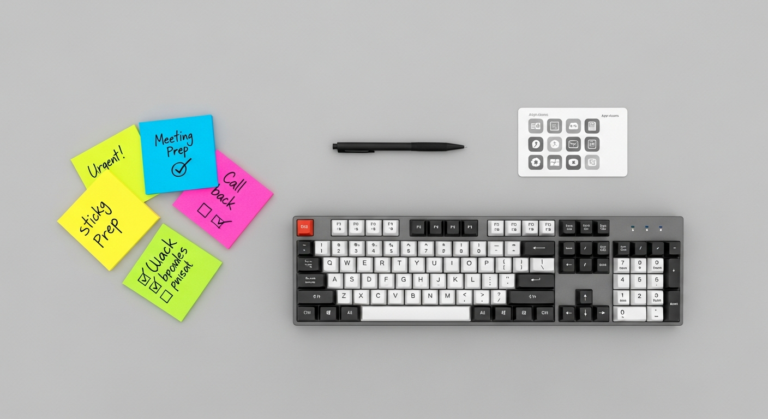
- Post-it Notes & Cheat Sheets: For your chosen shortcuts, write them down and stick them on your monitor. This visual reminder will prompt you to use them instead of reaching for the mouse. Many apps also offer printable shortcut cheat sheets.
- Deliberate Practice: Force yourself. When you’re about to click, pause. Ask yourself, “Is there a shortcut for this?” If you don’t know, quickly look it up. The momentary delay will reinforce the learning process.
- Observe & Learn: Pay attention to the menus in your applications. Often, the shortcut for a command is listed right next to it (e.g., “Save Ctrl+S”). In Windows applications, pressing the
Altkey often reveals underlined letters that indicate shortcuts for menu items. - Consistency is Key: Like learning a musical instrument or a new language, muscle memory builds with repetition. The more consistently you use shortcuts, the faster they become ingrained.
- Don’t Be Afraid to Look Up: Google is your best friend. If you’re wondering “shortcut for new tab chrome” or “excel sum shortcut,” a quick search will usually give you the answer instantly. Tools like KeyCombiner can also help you discover and practice shortcuts.
- Customize Your Keyboard: If you’re serious about shortcuts, consider a programmable keyboard or remapping keys using software like SharpKeys (Windows) or Karabiner-Elements (macOS). This allows you to place frequently used keys in more ergonomic positions or create custom hotkeys for specific actions.