Mastering the Digital Workspace: A Guide to Workflow Optimization with Browser Tools (2026 Edition)
In the modern digital landscape, the web browser is no longer just a window to the internet; it is the primary operating system for our professional and academic lives. Whether you are a project manager juggling a dozen SaaS platforms or a student synthesizing research from disparate academic journals, the browser is where the work happens. However, as our digital dependency grows, so does the chaos. Tab sprawl, notification fatigue, and fragmented information can turn a powerful tool into a productivity sinkhole.
Workflow optimization with browser tools is the art of reclaiming your focus and streamlining your digital environment. By 2026, the integration of AI-driven extensions and sophisticated tab management systems has revolutionized how we interact with the web. This guide explores how professionals and students can leverage modern browser tools to build a seamless, high-performance workflow. From automating repetitive tasks to curating a “second brain” of information, mastering your browser is the first step toward true digital fluency and peak productivity.
—
1. The Psychology of a Clean Browser: Why Workflow Optimization Matters
The visual clutter of twenty open tabs is more than an aesthetic issue; it is a cognitive one. Every open tab represents an unfinished task or a piece of information competing for your attention. This phenomenon, often referred to as “cognitive load,” significantly impairs our ability to engage in deep work. When your browser is disorganized, your brain spends a non-trivial amount of energy simply navigating the interface, leaving less power for the actual task at hand.
Workflow optimization serves as a digital decluttering process. By using browser tools to categorize, hide, or archive information, you reduce “context switching”—the productivity-killing habit of jumping between unrelated tasks. For professionals, this means being able to switch from a client meeting to a financial report without seeing the distracting remnants of previous tasks. For students, it means maintaining a focused environment where research materials are organized by subject rather than scattered chronologically across a browsing history.
In 2026, the most successful digital workers are those who treat their browser as a curated workspace rather than a catch-all bin. Optimization allows for a “state of flow,” where the tools disappear, and the focus remains entirely on creation and analysis.
2. Beyond Bookmarks: Advanced Tab Management for Deep Work
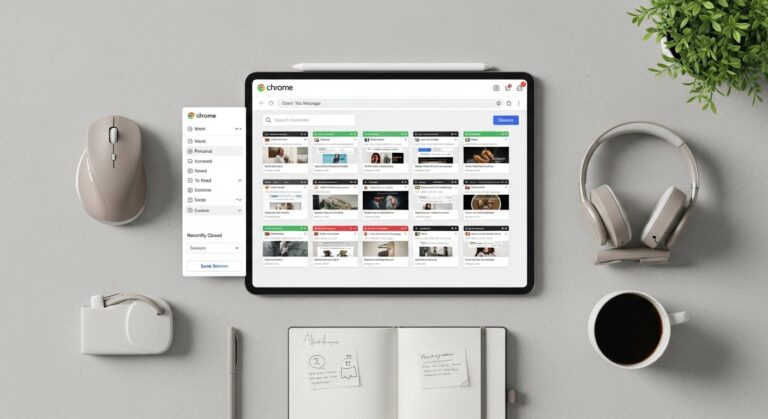
The humble bookmark folder is largely a relic of the past. Modern workflows require dynamic, fluid ways to manage active sessions. Tab management tools have evolved into comprehensive “workspaces” that allow users to save entire states of their browser for specific projects.
#
Workspaces and Grouping
Modern browsers like Chrome, Edge, and the innovative Arc browser have introduced native tab grouping. For a student, this might mean a “Thesis Research” group and a “Personal Finances” group. However, third-party extensions like **Workona** or **Toby** take this further. They allow you to suspend inactive tabs to save RAM while keeping the project structure intact. This ensures that when you return to a project three days later, every resource you need is exactly where you left it.
#
Vertical Tabs and Sidebar Navigation
The traditional horizontal tab bar is inefficient for those who regularly have 30+ tabs open. Vertical tab layouts, now standard in many productivity-focused browsers, allow you to read the full titles of your tabs at a glance. This reduces the time spent clicking through “mystery tabs” to find the right document. By moving navigation to a sidebar, you also gain more vertical screen real estate, which is essential for reading long-form articles or coding.
3. Automating the Mundane: Integration and AI Browser Tools
The most significant leap in workflow optimization has been the rise of browser-based automation. We are moving away from manually copying and pasting data between web apps. Today, tools like **Bardeen** or **Zapier Central** allow users to build “playbooks” directly within their browser.
#
AI-Powered Research and Synthesis
In 2026, AI extensions have moved beyond simple chatbots. They now act as context-aware assistants that live in your browser’s sidebar. For professionals, these tools can summarize long email threads, extract action items from meeting notes, or synthesize market research from five different websites simultaneously. For students, AI tools can help in “Active Reading”—highlighting key arguments in a PDF and automatically cross-referencing them with other saved sources in their library.
#
No-Code Browser Automation
Workflow optimization also involves automating repetitive administrative tasks. Imagine an extension that detects whenever you are looking at a LinkedIn profile and offers a one-click button to save that person’s info to your Notion database or CRM. These “scrapers” and “trigger-based” tools eliminate the friction of data entry, allowing professionals to focus on relationship building and students to focus on learning rather than logistics.
4. Content Curation and Organization: Turning the Web into a Personal Library
One of the biggest challenges for digital workers is “information rot”—saving a link and never finding it again. Workflow optimization requires a robust system for content curation. This is where the concept of a “Second Brain” comes into play, utilizing the browser as the primary input device.
#
Highlighting and Annotation
Tools like **Raindrop.io** or **Hypothesis** allow users to highlight text directly on a live webpage. These highlights aren’t just visual; they are indexed and searchable. A student can annotate a digital journal article, and those notes will automatically sync to their primary note-taking app. This bridges the gap between “consuming” information and “owning” it.
#
Integrated Knowledge Management
The best browser tools are those that talk to your existing ecosystem. Extensions for **Notion**, **Obsidian**, or **Evernote** allow you to “clip” web content directly into specific project folders. Instead of a messy list of URLs, your browser becomes a gateway to a structured library of assets. By tagging content at the moment of discovery, you save hours of reorganization time later in the week.
5. Privacy, Security, and Performance in a Browser-Centric Workflow
An optimized workflow is only as good as its stability and security. As we move more of our professional lives into the browser, the risks of data breaches and performance lag increase. Optimization must include a focus on “browser hygiene.”
#
Password and Identity Management
Using a dedicated password manager extension (like **Bitwarden** or **1Password**) is non-negotiable. These tools do more than store passwords; they facilitate “one-click” logins and secure sharing of credentials within teams. This removes the friction of forgotten passwords and the security risk of using the same password across multiple platforms.
#
Managing Extension Bloat
While browser tools are powerful, having too many can slow down your system and create security vulnerabilities. Part of an optimized workflow is a “monthly audit” of your extensions. In 2026, many browsers offer “extension profiles,” allowing you to have one set of tools active for “Work” (e.g., SEO tools, CRM integrations) and a different, leaner set for “Focus” (e.g., ad blockers, read-it-later tools). This ensures that your browser performance remains snappy even during intensive multitasking.
6. Building Your Custom Toolkit: Recommended Tools for 2026
To help you get started, here is a breakdown of essential categories for your browser optimization toolkit.
* **For Organization:** *Workona* (for session management), *Raindrop.io* (for bookmarking and curation).
* **For Focus:** *Forest* (to gamify focus time), *uBlock Origin* (to remove distracting ads and trackers).
* **For Research:** *Readwise Reader* (for highlighting), *Zotero* (essential for academic citations).
* **For Automation:** *Bardeen* (for browser-based no-code automation), *Grammarly* (for real-time communication refinement).
* **For AI-Assisted Work:** *Perplexity* or *Claude* sidebar extensions (for real-time research synthesis).
The key is not to install all of these at once. Start with one pain point—perhaps your messy tabs—and master a tool that solves it before moving on to the next level of optimization.
—
FAQ: Frequently Asked Questions
**Q1: Will using too many browser extensions slow down my computer?**
Yes, every extension consumes a small amount of memory (RAM). However, modern browsers are very efficient at “sleeping” inactive extensions. To maintain high performance, only keep extensions enabled that you use daily, and use a tool like “Tab Suspender” to manage the memory usage of your open websites.
**Q2: Which browser is currently best for professional productivity in 2026?**
While Chrome remains the most popular due to its vast extension library, **Microsoft Edge** and **Arc** have become leaders in productivity features. Edge offers excellent built-in PDF tools and vertical tabs, while Arc is designed specifically for those who want to treat their browser like a structured workspace.
**Q3: Is it safe to give browser tools access to my data?**
Security is paramount. Only install extensions from the official web stores (Chrome Web Store, etc.) and check the permissions they request. Avoid “free” extensions that don’t have a clear business model, as they may be selling your browsing data. Stick to well-known developers with high ratings and transparent privacy policies.
**Q4: How can students specifically benefit from browser automation?**
Students can use automation to streamline their bibliography creation, sync their class schedules with their task managers, and even automate the process of saving lecture slides to their cloud storage. It allows them to spend more time studying the material and less time organizing it.
**Q5: Can I sync my optimized browser setup across different computers?**
Absolutely. Most modern browsers allow you to sign in with an account (Google, Microsoft, or Apple) to sync your extensions, bookmarks, and settings. However, for specialized tools like Workona or Notion, you will need to log in to those specific services to see your saved workspaces on a new device.
—
Conclusion: The Browser as Your Digital Headquarters
Workflow optimization with browser tools is not a one-time setup; it is a continuous process of refinement. As we move further into 2026, the boundaries between the internet and our personal files continue to blur. By mastering the tools at your disposal, you transform the browser from a chaotic portal into a streamlined digital headquarters.
For professionals, this optimization leads to faster project delivery and reduced burnout. For students, it provides the structure necessary to navigate the vast sea of information available today. The goal is simple: spend less time fighting your interface and more time doing the work that matters. Start small, audit your current habits, and build a browser environment that supports your goals rather than distracting you from them. In the digital age, your browser is your most important tool—make sure it’s sharpened.